A quick fix to boost holiday mobile engagement

One of the surprising results of the 2012 MarketLive Consumer Shopping Survey was the strong showing forecast for mobile in the holiday season to come. By now, heavy mobile researching is to be expected, but the survey revealed that a large percentage of consumers plan to go beyond browsing to use their devices to transact purchases. Specifically:

  • One in five survey participants plan to make purchases on their mobile devices during the holiday season
  • 43% said they would use their mobile devices to redeem coupons in-store
  • 82% said they would use retail apps to make purchases

With such potential for direct contribution to the bottom line, mobile offerings deserve prominent promotion. But often, the only mention of mobile on the flagship eCommerce site is a small link in the footer — or, worse, there’s none at all. With the holiday season right around the corner, merchants should act immediately to highlight whatever mobile offerings they have — using all the touchpoints to cross-promote their services. Specifically, merchants should:

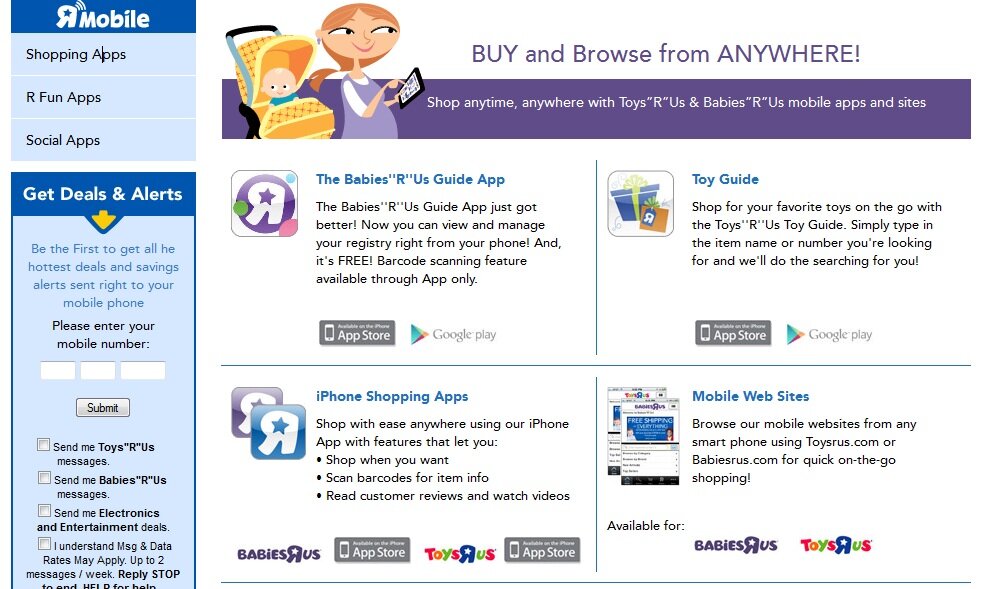
Go big with details on the eCommerce site. On the flagship eCommerce site designed for viewing on desktops or browsers, devote a page or more to mobile offerings, detailing what’s available through text-message alerts, the mobile Web and on custom apps. Toys R Us features a page detailing its three mobile apps, with links to download each, along with its mobile Web site. With the heading “Buy and browse from anywhere!” the page emphasizes convenience, calling out the ability to scan item barcodes for registries and research and to access “quick on-the-go shopping”. The left-hand column invites browsers to sign up for text-message alerts by emphasizing “the hottest deals and savings” and allows subscribers to select which categories of alerts they’d like to receive.

Mobile promotion example by Toys R Us

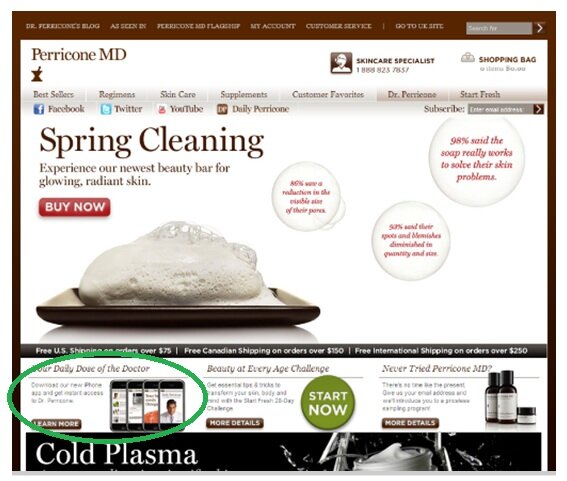
Additionally, merchants should consider linking to mobile information from a promotion on the home page and/or in the global header, as MarketLive merchant Perricone MD did when launching its new iPhone app. The home page promotion promises “instant access” to health advice.

Mobile promotion example from Perricone MD

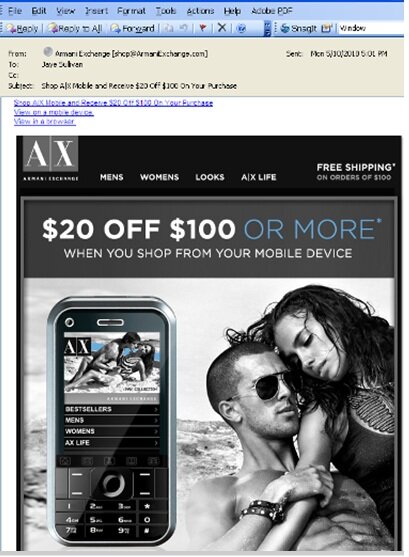
Alert email subscribers to new ways to shop. Email subscribers are already familiar with the brand and may already even be customers — but that doesn’t mean they don’t have any interest in shopping via mobile device as well as on the traditional Web site. Message them with a promotional offer exclusive to mobile shoppers, as MarketLive merchant Armani Exchange did with this message promising $20 off mobile orders of $100 or more. After the campaign, the mobile site saw a three-fold increase in conversions.

Mobile promotion example from Armani Exchange

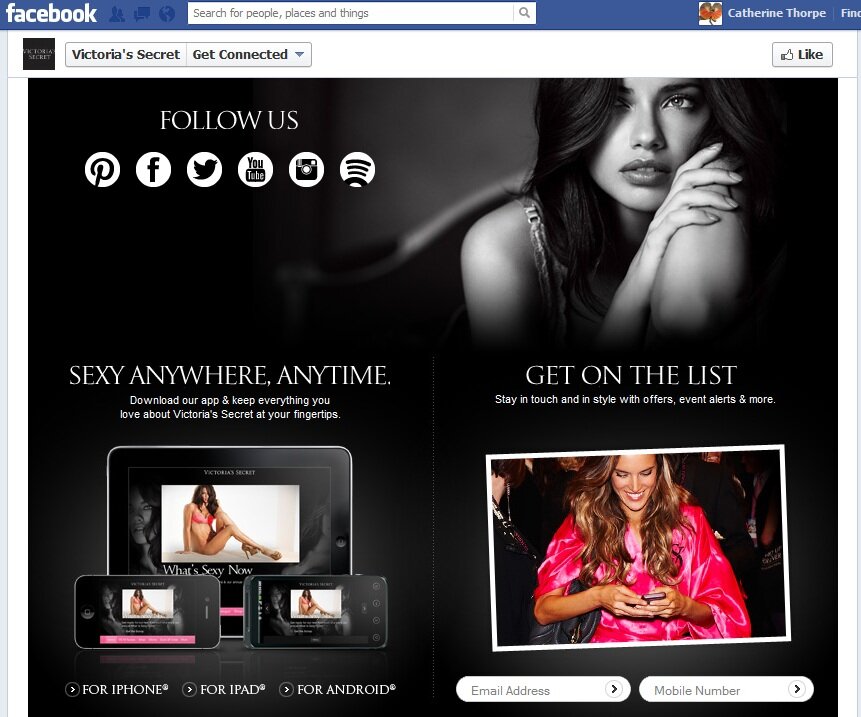
Reach mobile-primed shoppers via social networks. Fully 80% of smartphone owners visit social networking sites, and more than half of them do so daily, according to data from Google and Ipsos. Merchants should engage this audience of mobile enthusiasts by promoting their offerings on social outposts, emphasizing the ability to access exclusive and up-to-the-minute content. Victoria’s Secret promotes its apps and mobile alerts service on a “Get Connected” page linked prominently from its main Facebook Timeline.

Mobile promotion example from Victoria's Secret

How are you promoting your mobile services across touchpoints?

Webinar recap: Offer value to win holiday sales

Our head’s still spinning from all the great information delivered during last week’s webinar on the 2012 MarketLive Consumer Shopping Survey. The survey covered a bevy of topics, from how shoppers plan to use mobile devices during the holidays to top discounting strategies for winning sales.

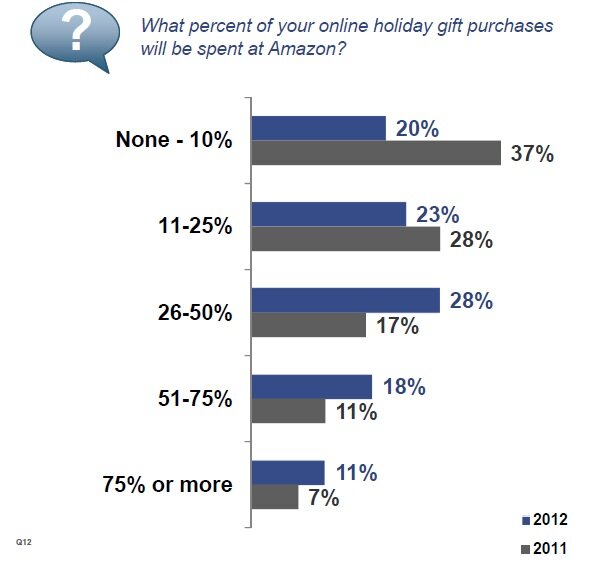
One key standout was the impact of Amazon.com. While most merchants are well aware of the online behemoth’s presence, it was eye-opening to see the numbers in black and white:  more than half of consumers planned to make at least a quarter of their purchases on Amazon — a 62% increase compared with last year — while nearly one in three plan to use the site for more than half of their holiday gifting.

Data from the MarketLive Consumer Survey 2012

Luckily, the webinar also offered an array of solid strategies for merchants to convince shoppers to purchase on their sites instead. The key? Communicating value — a concept that goes beyond prices to include service, brand reputation and uniqueness of products. Value topped the list of product and price factors that influence purchases, with 87% of survey participants saying it’s important — just ahead of product price alone, which 85% of participants said was a priority. Merchants who make the most of that value advantage will thrive, said presenter Lauren Freeman of the E-Tailing Group. Just a few of the tactics the survey identified for communicating brand value:
Reliability. Merchants whose products are in-stock and guaranteed for holiday delivery win points, the survey found, with 82% and 74% of shoppers saying they’re important, respectively. Delivery and shipping cutoff dates also scored high, with 66% of consumers saying they’re important. In addition to communicating in-stock status on the product page, merchants can easily build brand value by creating a clear guide to holiday shipping deadlines and promoting it prominently throughout the site, as  Sundance Catalog did last year with a home-page callout of delivery cutoff dates.

Holiday example from Sundance

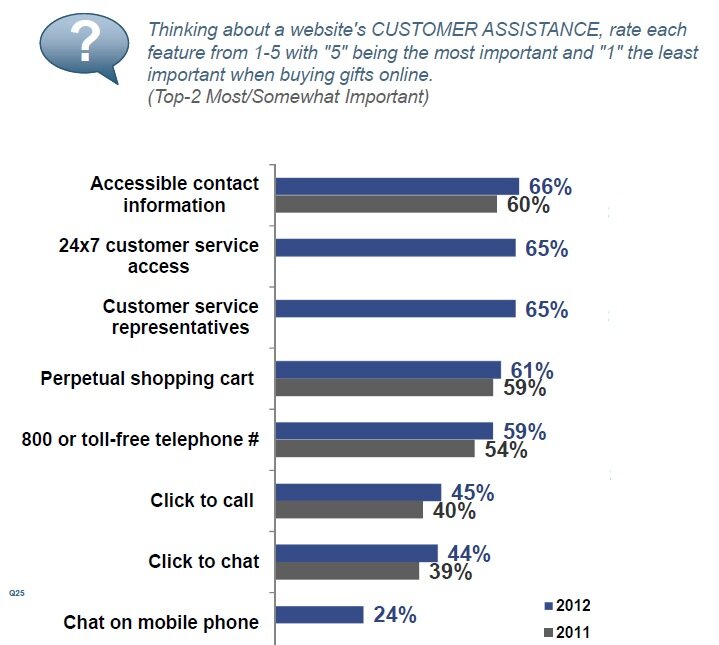
Customer service. Unlike Amazon, small and mid-sized merchants can deliver exceptional personalized service — and according to the survey, consumers acknowledge the importance of customer assistance. The availability of a variety of contact options is key, from an 800 number to “click-to-chat” functionality, as is 24/7 access, which was rated important by 65% of participants.

Data from the 2012 MarketLive Consumer Shopping Survey

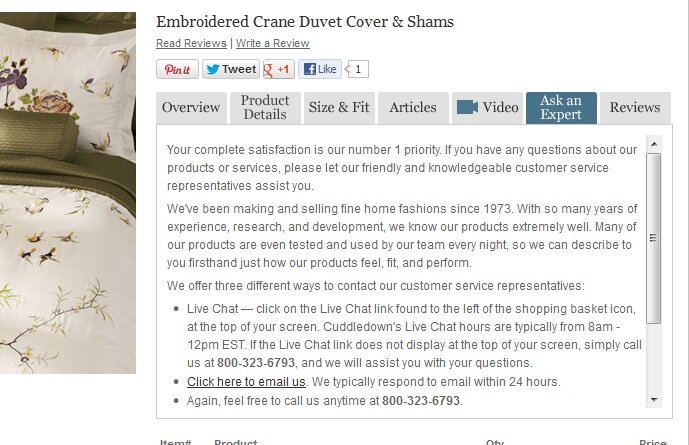
While not every merchant can offer assistance in every form around the clock, it’s crucial to prominently feature the customer service options that are available — not only on the “contact us” page, but in the global header and on individual product pages, as housewares merchant Cuddledown does with an “Ask an Expert” tab that details contact information and hours.
Customer service example from Cuddledown

Expertly-curated gifts. Nearly half of survey participants, 45%, said the availability of recommendations or reviews was a reason they shopped online — up significantly from 2011, when just over a third of shoppers rated the information important. To create brand value, merchants can go beyond offering customer reviews and feature individual picks from staff members or resident experts in their gift guides. Not only does the brand’s credibility receive a boost by giving shoppers a glimpse of the knowledgeable people who work behind the scenes; a well-crafted gift guide serves as a reminder of the brand’s authoritative good taste and selection of relevant products — a different experience than Amazon’s mega-store mentality.

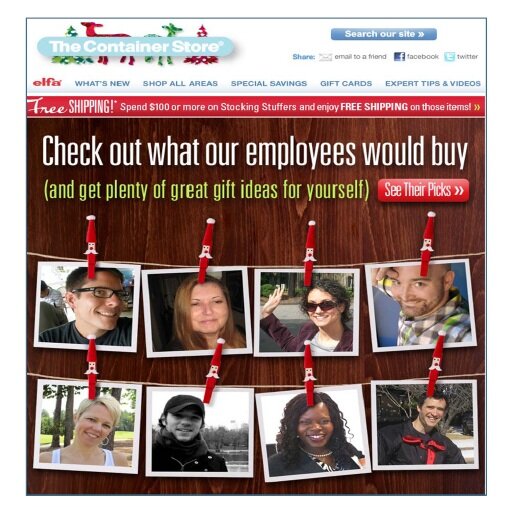
The Container Store spotlighted its on-staff experts in an email campaign last year with the Subject: line “Trust our employees to pick great gifts.” The message content touted “what our employees would buy” and linked to a selection of gift picks for each featured staff member.

Example of staff picks from the Container Store

There’s more survey data to share in upcoming posts — but meantime, what are you doing to communicate the value of your brand during the holiday season?

Webinar preview: Maximizing holiday sales success

The National Retail Federation’s Shop.org has released its holiday forecast, predicting that online sales will grow 12.6% year over year. That estimate is lower than the earlier forecast from eMarketer, which predicted growth of nearly 17%, and also lower than last year’s sales growth of 15%, as measured by the U.S. Department of Commerce.

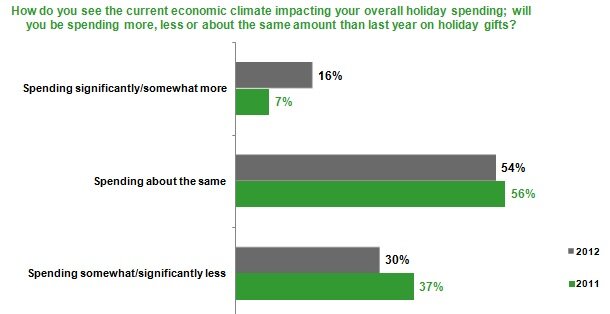
While it’s impossible to know whose crystal-ball prognostications will be more accurate, the lower figure squares with the new data collected for the 2012 MarketLive Consumer Shopping Survey, which polled more than 1,000 U.S. shoppers about their plans for holiday spending. The majority of participants, 54%, said they plan to spend about the same amount as last year — down from 56% last year; the percentage of respondents who said they plan to spend more more than doubled, but remains small at 16%, while fewer than 1 in 3 participants said they planned to spend less.

MarketLive 2012 Consumer Shopping Survey data

The data confirms that while the prospects are good for holiday success, merchants will have to work harder than ever to convince shoppers to spend more. The proposition is even more difficult for small-to-medium-sized merchants, who may not be able to compete on price alone with mega-players such as Amazon and Wal-Mart.

But there are plenty of ways merchants can thrive this holiday season despite the challenges. As we’ll reveal in a comprehensive review of survey results tomorrow, October 10, the key to success is to provide value — which doesn’t always equate to bargain-basement pricing. Among other topics, the webinar will explore:

  • What gifting features are most popular for merchants to offer
  • The promotions most likely to motivate purchasing
  • How Amazon impacts holiday shopping behavior
  • Whether shoppers plan to buy — not just research — via their mobile devices
  • How social media can help merchants drive holiday sales

In addition, the webinar will feature a bevy of examples and tactics merchants can apply immediately to boost the success of their holiday campaigns. Register for the webinar now – and stay tuned to the blog for holiday tips throughout the season.

First holiday forecasts promise another year of sales growth

Back-to-school season is barely over, but with the end-of-year peak season closing in fast, the first forecasts for holiday shopping have already appeared — and they portend another year of potential gains as well as challenges.

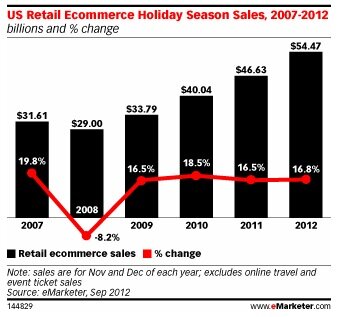
According to market researcher eMarketer, online sales will grow 16.8% this November and December compared with 2011, a slight uptick from the 16.5% growth rate last year. Holiday sales will total more than $54 billion and represent almost a quarter of annual eCommerce revenues for 2012, eMarketer predicts.

Holiday forecast from eMarketer

Overall retail sales are also poised to grow, with research firm ShopperTrak predicting a year-over-year sales increase of 3.3%. That rate is slightly below 2011, which logged 3.7% growth compared with the prior year.

Both sets of predictions hint that merchants face a challenging, but potentially lucrative environment for the holidays: with overall sales growth falling and online sales growth slowing, merchants will have to work harder than ever to reach shoppers who log on for the convenience, savings and selection they’ve come to expect from the online experience.

In a post over the summer, we recommended merchants begin fine-turning their sites for holiday success. Now, with many merchants rapidly approaching “lock-down” mode for their sites and marketing strategies firmly in place, it’s still worthwhile to tweak plans in order to:

Make the most of whatever shipping discounts are on offer. Free shipping is the top promotion that motivates consumers to buy, but low flat-rate shipping and free upgrades to expedited shipping are also worth promoting.

Showcase any cross-channel capabilities. The ShopperTrak forecast predicts that foot traffic to stores will be up 2.8%, in contrast with last year’s 2.2% drop. Merchants with brick-and-mortar locations should fine-tune campaigns to support both online and offline buying.

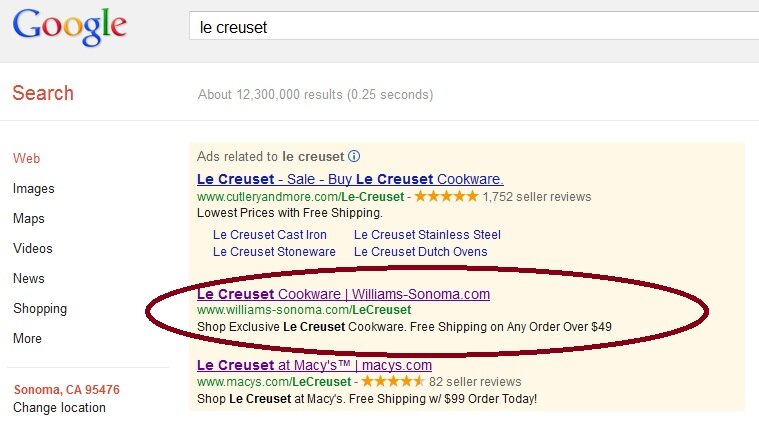
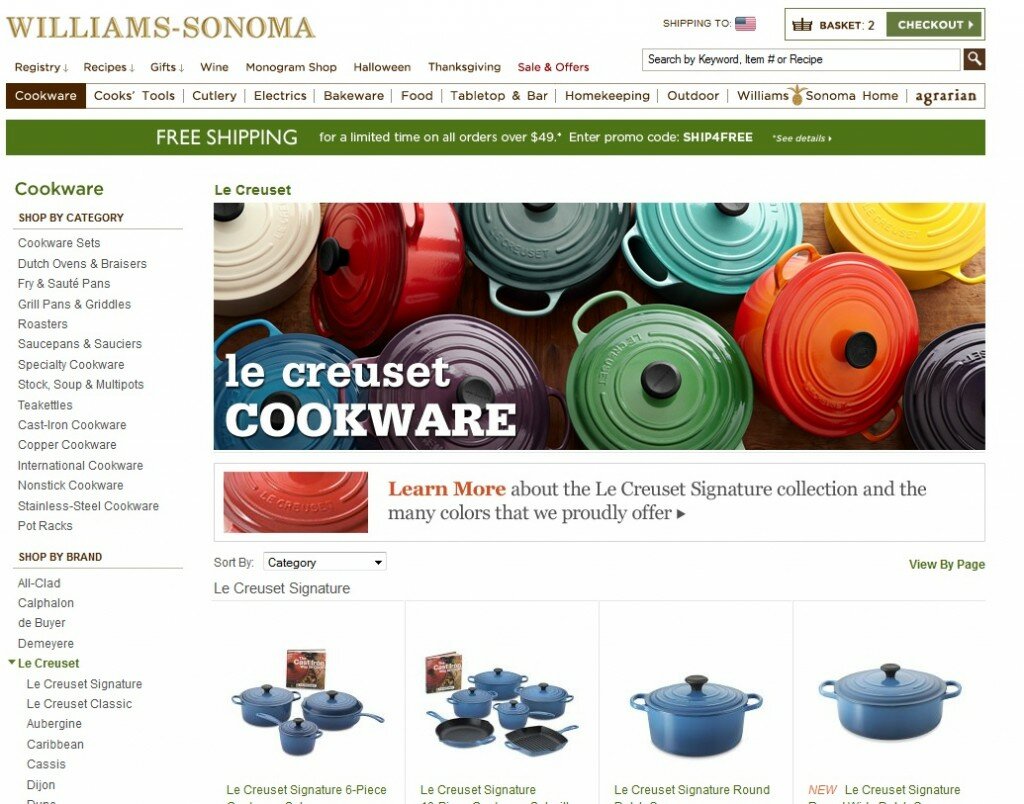
Ensure the transition from link to landing page is airtight. Email promotions and paid search placements should lead shoppers to content that delivers on the promise that caused them to click in the first place — ideally offering further opportunities for engagement as well as comprehensive information to power a purchase decision.   Williams-Sonoma’s paid search ad for Le Creuset cookware mentions exclusive offerings and free shipping above a $49 threshold — themes that are repeated on the landing page, which features the shipping offer in a banner at the top of the content area and offers shoppers a link to in-depth content about the Signature Collection on offer.

Paid search placement example from Williams-Sonoma

Landing page example from Williams-Sonoma

For more holiday strategies and consumer trends, be sure to mark your calendars for October 10, when MarketLive will present the results of its 2012 Consumer Shopping Survey, along with trends and tactics to maximize sales. Register for the webinar now — and meantime, let us know — how are you fine-tuning your holiday strategies?

Making a (wish) list, checking it twice

As we noted in an earlier post, wish lists give browsers and researchers somewhere other than the shopping cart to stash items of potential interest. And with the holiday season right around the corner, wish lists have the potential to stimulate significant sales. Not only will gift buyers be on the lookout for suggestions from recipients, but shoppers who designate items on their wish lists may end up buying them for themselves.  In 2011, nearly six in 10 shoppers set aside holiday shopping money for themselves, according to the National Retail Federation.

Although it’s late to deploy major technology upgrades to change wishlist functionality, merchants can still make tweaks to help drive wish list usage and convert those lists to sales. Consider the following techniques:

Spotlight the wish list prominently. Go beyond including a text link to the wish list in the global header or footer and incorporate wish list prompts throughout the site: promote wish list usage on category pages, in gift guides and on product pages, where it should be listed as an option along with social links and “forward to a friend.” If you have a loyalty club, consider awarding members extra points for wish list usage, as American Eagle did last year, when it gave members 25 points for wish list creation and another 10 points for sharing the lists.

Wish list incentive from American Eagle Outfitters

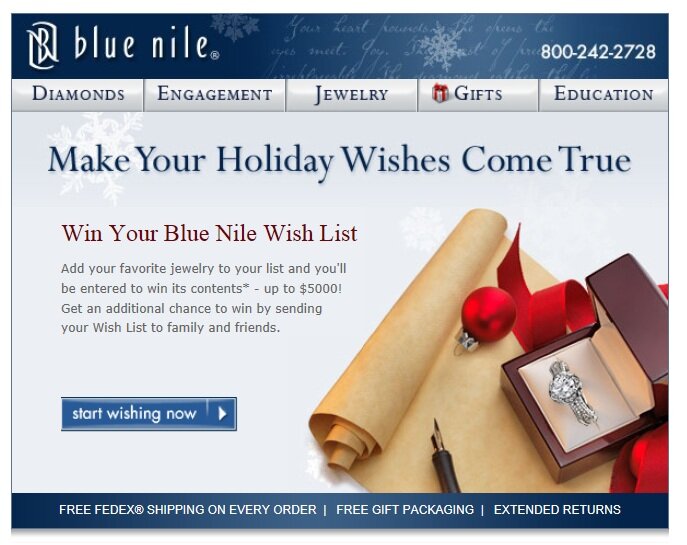
Consider building a promotional campaign around wish list usage, such as last year’s “win your wish list” sweepstakes offered by jeweler Blue Nile. After Christmas, incorporate wish list messaging into post-holiday “get what you really wanted” campaigns.

Wish list example from Blue Nile

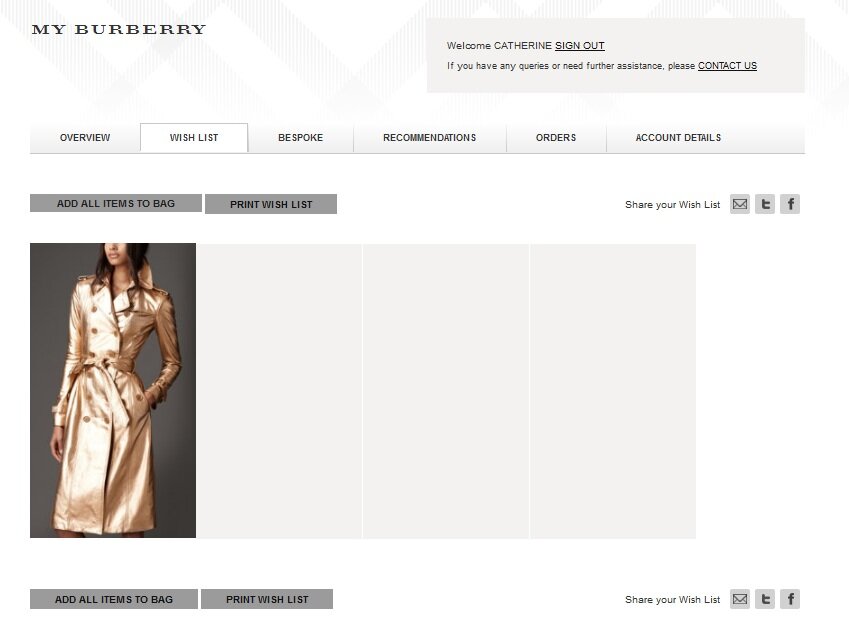
Help shoppers share everywhere. Let shoppers share and use their wish lists wherever they choose. In addition to allowing shoppers to email their wish lists to friends, add social sharing links so that lists can be posted to Facebook and Twitter; include a “print” button so shoppers can physically hand their lists over. High fashion merchant Burberry enables all the options for its wish list, with icons for Facebook, Twitter and email and a button for printing.

Wish list example from Burberry

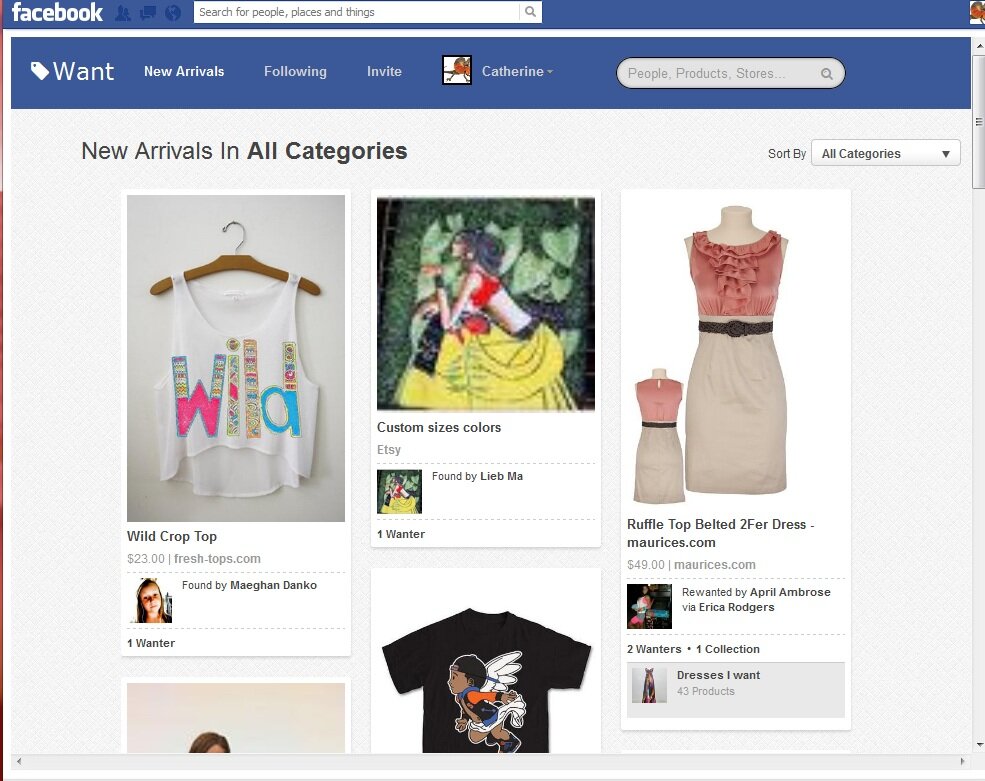
The social sharing technology Want offers a quick wish list sharing fix. When users click a “want” button on a product page, the item is shared in their Facebook news feed; their timelines display the full list of items they’ve designated from multiple retailers, while all users’ selections are compiled on an image-driven Want site and Facebook page. The company claims that 38% of items posted to Facebook are clicked on by shoppers’ friends.

Wishlist technology Want

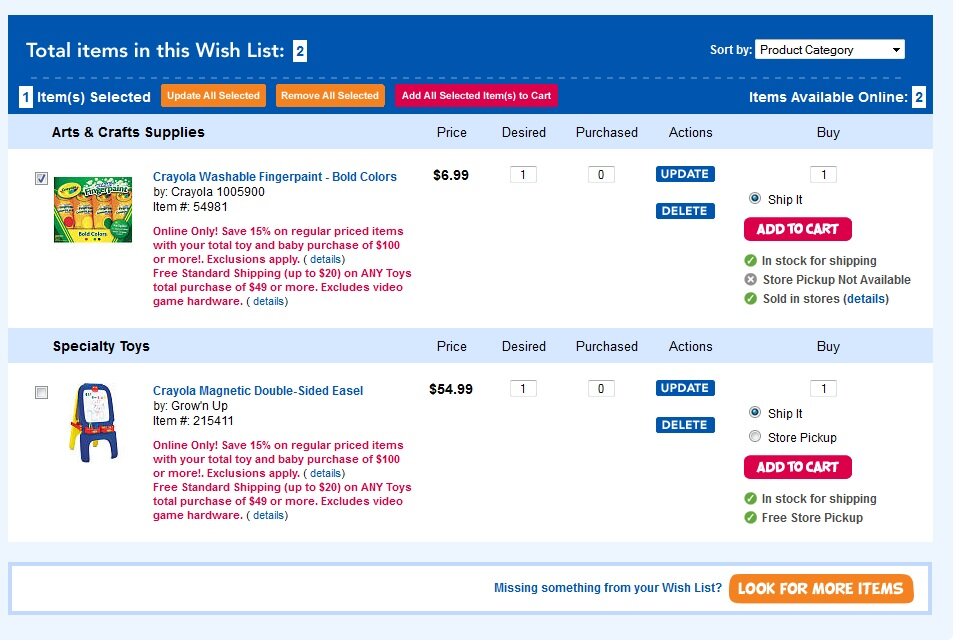
Smooth the transition from list to cart. If time and resources are available to work on functionality, ensure that buying items from wish lists is a simple a process. Beyond providing a link to add items to the cart, consider including in-stock information in the wish list display, and allow viewers to change the quantity or SKU options such as size or color. Toys R Us allows shoppers to buy individual items or to select multiple products to add to the cart; additionally, in-stock and delivery options are displayed, along with a free shipping and discount promotion.

Wish list example from Toys R Us

What measures are you taking to encourage wish list building and buying this holiday season?

Christmas in July: What to do now for holiday success

Now that the Fourth of July is in the rearview mirror, the end-of-year holiday season looms on the horizon — and for merchants, the stakes couldn’t be higher.  Industry researcher Forrester estimates that from 2005 to 2011, online purchases have increased from 5% to 12% of total retail holiday sales — a 140% increase — and the growth trend is set to continue.

With so much at stake, merchants have been developing their fourth-quarter strategies all year and implementing the technology upgrades they need to remain competitive. While now is probably already too late to add to the list of major new features to devise, deploy and test before the holiday kickoff, there are a variety of site tweaks and marketing strategies merchants can undertake to maximize their chances of holiday success. Top priorities:

Run the numbers on season-long free shipping with no threshold — or formulate alternatives. Painful as its impact on the bottom line is for merchants to contemplate, free shipping with no threshold is a consumer favorite. In the 2011 MarketLive Consumer Shopping Survey, conducted just prior to the holiday season, 45% of participants said high shipping costs prevented them from buying more gifts online, and unconditional free shipping was the top-rated promotion shoppers said would influence their purchase decision.

Because of its popularity, a handful of large brands now offer free shipping with no threshold year-round — upping consumers’ expectations still further. For most merchants, even offering it for the duration of the holiday season is an expensive proposition — but it’s worth contemplating for the competitive advantage it could afford your brand.

If you can’t offer free unconditional shipping for the duration of the season, consider offering it in small doses, such as:

  • On red-letter shopping days. Black Friday, Cyber Monday, “Green Monday” (the second Monday in December) and Free Shipping Day to start.
  • For limited time frames within a single day, such as night-owl, early-bird or lunch-hour specials.
  • For loyalty club members only, or for customers with a high lifetime value.

Bedding company Cuddledown put a wry spin on a weekend-long shipping discount last year, saying “just please don’t tell our boss” that free shipping with no threshold was on offer.

Holiday offer example from MarketLive merchant Cuddledown

Beef up content. Offering holiday shoppers deep, relevant content can instill trust and help guide their gift purchases. In particular, in preparation for the peak season merchants should beef up content that helps shoppers:

  • Research. Forrester estimates that in 2011, fully 36% of all purchases – not just online purchases – were influenced by the Web in some way, with product and brand research leading the list of online shopping behaviors. Merchants should provide a robust content toolset to assist potential gift buyers with their research.
  • Find gifts. Buying guides, product demonstration videos, and categories for top-rated items all help shoppers connect with the products that are just right for recipients on their list.
  • Get help. Building comprehensive information to assist shoppers with their purchase decision demonstrates the credibility of the brand. And during the frantic holiday season, when shipping costs and delivery deadlines take center stage, robust customer service content is more important than ever.
  • Discover new pathways to purchase. In addition to providing fodder for consumers conducting product research, lifestyle content such as blog posts and articles can help boost merchants’ SEO rankings for non-branded terms, potentially bringing new audiences to the brand, as the graphic below illustrates.

MarketLive chart showing new pathways to purchase via lifestyle content

Add as much cross-channel mobile capability as you can support. Mobile research is likely to be prevalent this holiday season; last year, according to IBM Coremetrics, more than one in 10 shoppers used a mobile device to visit a merchant’s Web site on Cyber Monday, compared to 3.9% of shoppers in 2010 — a more than 175% increase.

To cater to such behaviors, merchants should amp up their mobile offerings to include as much information about in-store activities as possible. In-store inventory integration is the ideal, but information that’s simpler to provide is also helpful to shoppers. Be sure to feature:

  • A robust, up-to-date store locator. Make sure your store locator is set to display holiday hours, local phone numbers and integrated mapping for easy access to turn-by-turn directions.
  • The skinny on store events and services. Special sales, in-store demos and gift wrap services are all relevant for holiday shoppers on the go.
  • Information on in-store pickup. Help connect online and offline touchpoints with prominent links to information about store delivery of items purchased online.

What holiday strategies are priorities for your business?

Holiday wrapup: MarketLive Performance Index shows strong gains

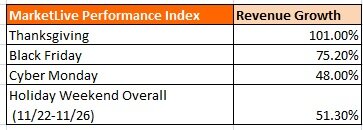
The final holiday numbers are in — and there’s much reason for merchants to rejoice. The latest numbers from online measurement firm comScore show a 14% revenue increase for Q4 2011, with sales totaling $49.7 billion.

Data from the MarketLive Performance IndexAnd, once again, it appears that the wealth wasn’t limited to major national brands and mass merchants. Year-over-year data from merchants listed in the MarketLive Performance Index in both 2010 and 2011 shows revenue gains of 20% for the fourth quarter — signaling that mid-market merchants thrived despite heavy competition and tight marketing budgets.

The “1-and-out” rate — the percentage of visits ending after viewing a single page — jumped significantly, signaling that more shoppers than ever clicked away from sites immediately if they didn’t spot the products or deals they sought. The increased “1-and-out” rate offset the overall traffic growth of 12.18% — which means that merchants’ efforts to connect shoppers with relevant offers was even more effective than the numbers suggest for those shoppers who stayed on-site.

Meantime, key performance indicators held steady year over year, with conversion, abandonment and engagement — the “add to cart” rate — all improving slightly. The data suggests merchants held their own in a challenging sales environment, and demonstrates that focused, targeted offers to likely buyers paid off in increased sales.

Closing the “1-and-out” gap
The growth of the “1-and-out” rate continues a trend we spotted in the second quarter of 2011, when MarketLive Performance Index showed continued growth in the percentage of flighty eCommerce site visitors who departed after a single page. To combat the trend, relevance — matching the right products and offers with the right shoppers — should be a priority for 2012.

Consider the following techniques, as outlined in Volume 15 of the Index:

  • Reduce the “1-and-out” rate beyond the home page. With SEO and paid search employing more deep links into eCommerce sites than ever, merchants must maximize the effectiveness of interior pages.
  • Capture the revenue potential of internal search. Despite the explosion of flashy new merchandising techniques and eCommerce shopping experiences, this tool remains a mainstay for driving eCommerce purchases – and merchants must optimize it more precisely than ever to deliver relevant results quickly.

Read the report for more data and examples — and watch for a new 2012 trends report coming soon with further strategies for the year ahead.

Holiday Countdown Tip #12: Thank email subscribers with a holiday “card”

Sending email subscribers a “season’s greetings” message on Christmas Eve or Christmas Day is an increasingly-popular tactic: nearly one in four major online retailers sent holiday wishes in 2010, up from 19% in 2009, according to email provider Responsys.

Of course, such messages can serve to spur post-season buying, and merchants are increasingly marrying holiday greetings with special offers. To walk the line between warm wishes and commerce:

  • Segment the mailing. You can boost the effectiveness of even such a seemingly-simple message by segmenting your list and tailoring the greeting accordingly. In particular, consider giving loyal customers a substantial thank-you gift, in the form of a free shipping or free gift with purchase offer to use in the post-season.
  • Make it brand-appropriate. Whether you showcase beautiful graphics or photography, or stick to a simple text-based approach, this message is a great opportunity to express your brand’s voice and identity. Williams-Sonoma, a kitchen outfitter, included a recipe with its holiday greeting “from our kitchen to yours.” Sent last December 24, the message used secondary space to promote e-gift cards that could still be delivered in time for Christmas the next day.

Holiday example from Williams-Sonoma

Holiday Countdown Tip #11: The second wave – post-season sales

This week may feel like the end of a long holiday season, with many merchants having begun promotions by late October. But far from being over, the final push of the holiday season is just about to begin: post-season shopping.

With the popularity of gift cards soaring and shoppers continuing to hunt for bargains, this year’s post-season shopping period may be more important than ever. To take advantage of the new wave of shopping activity:

  • Be prepared by Dec. 25. Much as shoppers took advantage of leisure time on Thanksgiving to browse and buy online, driving an 18% increase in sales according to measurement firm ComScore, so should merchants be prepared for post-season shopping to seep into Christmas day.
  • Spotlight redemption, return and exchange policies. Showcase all the ways shoppers can participate — whether by using their gift cards or returning or exchanging unwanted items. Delineate online versus in-store policies, and prominently position customer service contacts across all your customer touchpoints – the eCommerce site, mobile site, and social outposts.
  • Promote self-indulgence. Now that the Santa-emblazoned gift wrap has been shelved for the year, shoppers can take advantage of sale prices to indulge their own desires.
  • Emphasize accessories. Spotlight items that go with holiday top-sellers, from apparel to electronics, as eBags did last year by promoting cases for the season’s most popular gadget gifts.

Holiday example from eBags

Holiday Countdown Tip #10: Shifting focus to in-store purchasing

Now that the ground shipping cutoff has passed and expedited shipping deadlines loom, the time has come to drive online shoppers to bricks-and-mortar locations to complete purchases. With 61% of shoppers reporting prior to the holidays that they planned to research products online before purchasing, according to the 2011 MarketLive Consumer Shopping Survey, it’s crucial to promote the online/in-store link.

Retailers and brand manufacturers alike can participate in this final holiday push, with brand manufacturers promoting outlets where shoppers can find their merchandise. To effectively move shoppers from the browser to the store:

  • Help shoppers find store locations. Make sure store locator links are prominent on your eCommerce and mobile sites; consider promoting your store locator and customer service contact information on your Facebook landing page.
  • If you offer in-store inventory lookup, promote it. If shoppers can view in-store product inventory through your eCommerce site, highlight this service with a global site banner, in email and on social outposts.
  • Promote in-store events prominently. Send geographically-targeted email to promote local store events and spotlight marquee events on the eCommerce site. Kitchenware retailer Sur La Table links from its home page to a promotion for “The Chef is In” store events, scheduled for Dec. 21-23, which offer shoppers the prospect of expert cooking advice along with a chance to stock up on last-minute gifts.

Holiday example from Sur La Table

Switch to our mobile site

WordPress SEO fine-tune by Meta SEO Pack from Poradnik Webmastera