Getting to know your mobile audience
February 23, 2012 Leave a Comment
With 84% of U.S. adults owning a mobile phone, mobile commerce is a huge opportunity — and should be a top priority for merchants in 2012. But before deploying a series of mobile tactics, it’s crucial to consider what’s right for the marketplace, your customers and your business.
After all, there’s no point designing a downloadable app if most of your customers prefer text alerts; and launching services without the capability to maintain them is folly regardless of the platform. To determine how your brand’s followers and customers use mobile phones:
- Study your Web analytics. Both fee-based tools such as Omniture and free services like Google Analytics have the ability to break out mobile traffic to your existing Web site. Pay particular attention to
-
- inbound traffic from email marketing. If a significant number of visits to a custom URL for an email promotion are from mobile devices, then your email subscribers are reading messages on their phones — and you should tailor your email content and design accordingly.
- how social followers connect. Again, study those inbound links from social sites — if significant traffic to those pages is from mobile devices, you can infer that your brand’s social followers are using Facebook and Twitter on the go.
- Survey existing customers. Ask existing customers and followers to take a brief survey on their mobile phone usage habits, and solicit participation via email marketing, social outposts and even, for your most loyal customers, direct one-to-one communication.
- Size up the competition. While there’s no need to “keep up with the Joneses” when it comes to mobile development if your audience doesn’t require it, it’s helpful to survey the competitive landscape and understand what expectations exist for mobile services in your type of business and industry. In particular:
-
- read reviews of competitors’ apps and study how many downloads they’ve achieved to determine whether and how you might follow suit.
- use your phone to view competitors’ email campaigns and Web sites and track how many competitors are optimizing for mobile.
As you collect and review data, keep these key questions in mind:
Smartphone or SMS?
It’s certainly true that , according to the Pew Internet & American Life Project — suggesting merchants need to provide the kind of feature-rich experiences associated with Web browsing and custom-developed mobile apps. And tablet ownership has more than tripled in a year, from 3 to 10% of the U.S. populace, Pew found.
But a deeper look at the numbers reveals that there are plenty of demographic disparities in smartphone ownership. Pew found that while a majority of young adults aged 25-24 own smartphones, the percentage drops off steeply for audiences over the age of 45. At the same time, among income brackets smartphone ownership was highest among the highest earners.
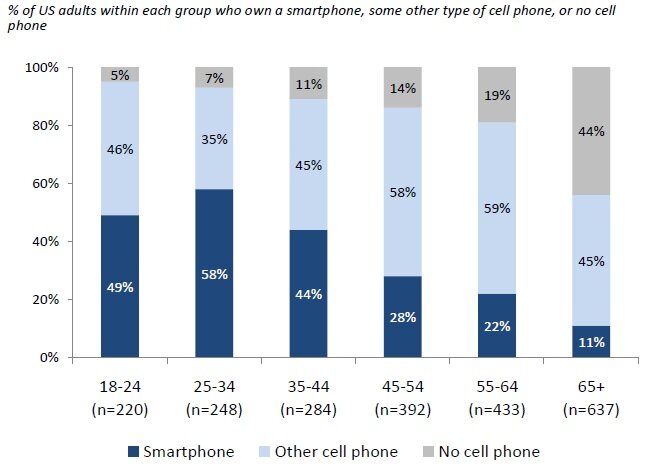
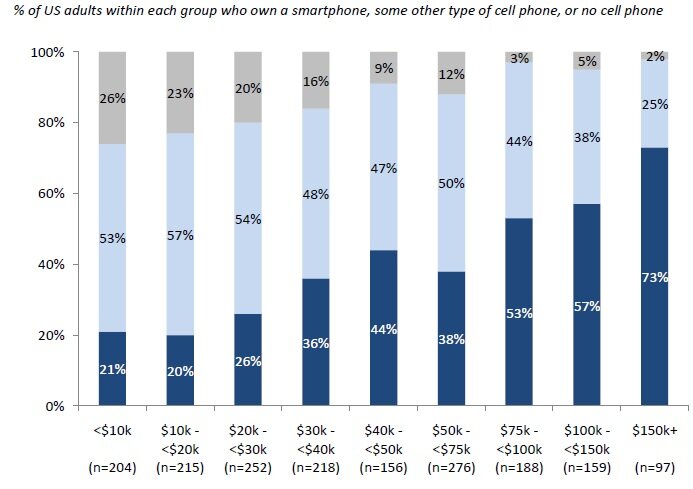
One potential interpretation would be to recommend that luxury purveyors and youth-centric merchants focus on the smartphone environment, while merchants catering to bargain-hunbters on a budget would do well to include such basic services as delivery of promotional offers by text message.
But the right mix will ultimately be determined by your business and the needs of your core audience — and will likely include a mix of SMS/MMS messaging campaigns and feature-rich offerings to browse.
Apps or mobile Web?
While ad slogans such as Apple’s “there’s an app for that” have put mobile applications in the spotlight, the fact of the matter is that most mobile purchasing is transacted through the mobile Web — that is, the mobile-adapted Web sites users view through the browsers on their phones.
According to industry researcher Forrester, 44% of mobile purchases were transacted through the mobile Web, compared with 33% of mobile shoppers who reported buying via an individual retailer’s app and 17% who said they used other types of shopping apps. A recent study from Yahoo/Ipsos found an even greater disparity, with fully , versus 27% who used applications.
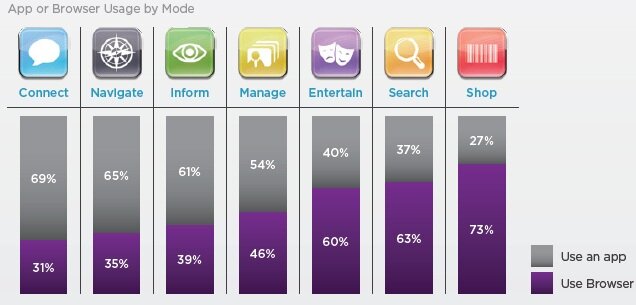
Here, too, the solution may not be either/or. While a mobile Web site is now a must, apps — like microsites — offer the ability to focus on a specific subset of products or to offer a solution to specific shoppers’ needs, such as new product alerts for the loyal brand followers who are more likely to download the app in the first place.
Putting it all together: developing a tiered strategy
To determine the best mobile strategy for your company in 2012, use the following grid to break out how shoppers can interact with your brand on their mobile devices — both in terms of technology, and in terms of their shopping goals. Based on their current behaviors and needs, you may decide to focus first on helping them research products by requesting information via text message codes, or share deals via social networks using the mobile Web.

We’ll take a closer look at how mobile can help shoppers achieve their goals in our upcoming mobile whitepaper.
Meantime, let us know: how do shoppers use mobile phones to access your brand? Have you developed an app? How do you determine future mobile development priorities?
Connect with us: